
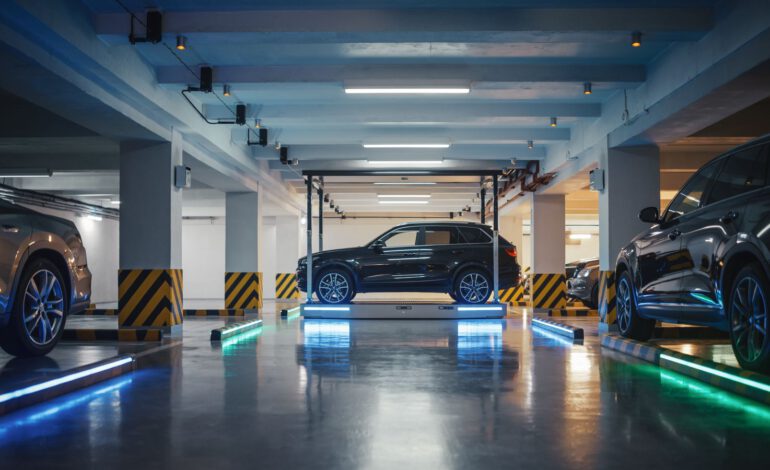
How Autonomous Robots will park your car in the future

When you spend hours researching computer hardware and AI chips (as I have recently), the social media algorithms eventually figure you out. My feed has shifted from random clips to heavy industrial robotics. And honestly? I’m not complaining, because sometimes you find a solution to a problem you didn’t even realize was so urgent.
I recently stumbled upon a clip that stopped me in my scroll. It shows a low-profile robot lifting a massive Mercedes G-Wagon effortlessly to park it. At first glance, it looks like a cool gadget for the super-rich. But if you look closer, you realize this technology addresses some very real issues in our crowded cities.
In a Nutshell: Clarity Over Noise
While self-driving cars get all the headlines, autonomous parking robots (like the “Parkie”) offer an immediate, practical solution. By lifting and arranging standard vehicles efficiently, they eliminate the need for driver space in garages, prevent damage, and offer a safer, barrier-free experience for elderly or less mobile drivers.
The “Magic Carpet” for Heavy Metal
Check out this clip. The precision is what gets me. It slides underneath, clamps the tires, and glides away with a vehicle that weighs over 2.5 tons.
Efficiency Over Autonomy
We often ask: “Why do we need robots if cars will soon drive themselves?” But that question overlooks the biggest constraint in modern architecture: Space.
Even a self-driving car needs enough space for the passenger to open the door and step out. A parking garage built for humans is full of “dead air”, space reserved only for door swings and walking paths.
A robot valet changes this equation. You drop your car off at a spacious transfer zone and walk away. The robot then stacks the cars inches apart from each other. In a crowded city center, this could theoretically increase garage capacity by 30 to 50 percent without building a single new wall. No more door dings and no more squeezing out of a tight spot while holding your breath.
Support, Not Just Replacement
It is easy to look at AI and robotics as technologies that are here to replace humans. But in this case, I see them as a massive support system, especially as our demographics shift.
Think about an aging population. For many elderly drivers, navigating a dark, tight, multi-level underground garage can be stressful or even dangerous. The physical act of parking in tight spaces requires neck flexibility and quick reflexes.
A system like this removes that friction entirely. You step out at a well-lit, safe lobby, and the machine handles the difficult logistics. It makes mobility accessible to more people for longer. This is the kind of AI I appreciate, technology that works quietly in the background to make everyday life a little bit smoother and safer.
Last updated: December 08, 2025